The leadership race must answer a fundamental question: Which path to defeating Ford actually works?
Key Takeaways:
- The Ontario Liberal leadership race must decide between three strategic models: a two-step approach focused on incremental gains, consolidating the progressive vote to challenge Ford directly, or positioning as the “serious” party of competence and national unity, each with distinct implications for coalition-building and policy priorities.
- The next leader must own a clear policy vision that reconnects Liberals with lost constituencies, particularly unions, young men, and rural voters, while emphasizing delivery-focused solutions on housing and healthcare rather than abstract promises, and establishing coherent governing values the party is willing to defend.
- The party’s relationship with the federal Liberals under Mark Carney will be crucial. If the provincial party chooses to align with Carney’s approach, it must fully commit through genuine coordination on policy and rebuilding integrated local organizations, not just borrowing rhetoric when convenient.
Get the latest MBP Intelligence briefings in your inbox:
No spam. Unsubscribe anytime.
Next week the rules for the Ontario Liberal leadership race will be released. It is expected that the race will conclude within this calendar year, leaving approximately a year and a half (maybe slightly longer) for a new leader to assert themselves before the next election. Some observers will be watching closely for how the rules committee answers major logistical questions, like whether the party will move to online voting or not. But for me, the big question is what path do those in the leadership race believe is the answer for those looking to remove Doug Ford?
Because beating Doug Ford is indeed possible and is more possible today than at any point since 2018.
Doug Ford announced this past weekend that he intends to run for a fourth term. The commitment to run can always be walked back, but we should assume he is serious, and that he remains a serious threat.
At the same time, there is a clear and growing desire for change in Ontario politics. The latest Liaison Strategies poll underscores this. It shows that “time for change” sentiment is rising, including among a meaningful share of Progressive Conservative voters themselves. Even more striking, the poll finds that a currently leaderless Ontario Liberal Party sits within roughly seven points of Ford’s PCs, close enough that a minority parliament is entirely plausible with the right campaign and vote distribution. The opportunity is real, but so is the risk of misreading it.
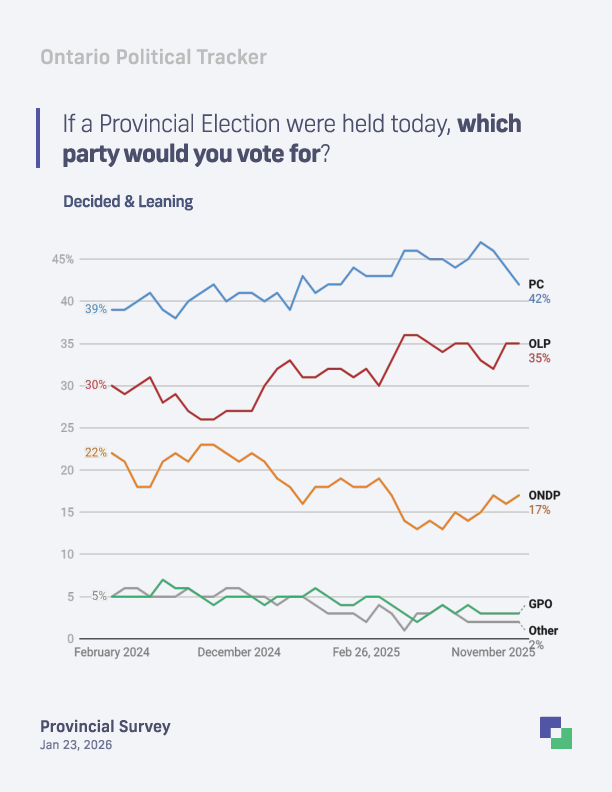
In that context, while there is a clear and growing desire for change, Liberals have to decide what kind of governing model they want to put forward. I see several options:
- A two-step strategy. The goal here would be to outmaneuver the NDP for official opposition and hold the government to either a minority or a reduced majority in 2026, rather than assuming an immediate path to victory. The objective would be incremental growth in seats and votes, with the new leader not needing to try to form government right away. The obvious approach would be to fish for disaffected Ford voters on the right who see housing and health care in crisis and who feel the Premier has drifted from basic competence and delivery. This is essentially the same approach Liberals tried in 2022 and 2025, but it hinges on making sizeable enough breakthroughs while still appealing across the spectrum.
- Sideline the NDP and consolidate the progressive vote. Under this model, the Liberals would position themselves clearly as the main alternative to Ford, aiming to hold the government to a minority at worst and, if the opportunity arises, launch a move similar to David Peterson’s in 1985 to remove the government. This would require sharper differentiation from the PCs on public services and affordability, while still convincing moderate voters that the party is not simply a softer version of the NDP. This model may even require thinking about the possibility of a coalition or confidence and supply arrangement with the opposition – something which is not actually controversial with voters but is with some partisans.
- Ignore Ford and focus on being the “serious” party. This path emphasizes productivity, growth, national unity, and Ontario’s place in a changing global order. This is effectively the “Carney plan” — an attempt to recreate the kind of competence-based, future-oriented politics that reassured voters federally. It would require selecting a leader with name recognition and experience, and building a deep platform that signals stability and vision. It would also need to circumvent the emotional lock the Premier currently has on how to handle Donald Trump, something we should admit he does well in a visceral sense that connects with our values and beliefs as Canadians, even if we have little concrete to show for it so far. This assumes that many of the same dynamics of geopolitical rupture will be with us for some time and that the Carney brand will endure (it could wear down a bit between now and 2028/29). Those are likely safe bets but some consideration needs to be given to how adaptable this current moment of politics is to broader and deeper desires among the public that still point in the direction of populism.
These are not mutually exclusive strategies, but they do pose important choices about who we are as a party and what we want to offer Ontarians. Inherent to these models are other fundamental choices about identity and coalition-building.
One is how the party reconnects with voter groups it has lost for a long time: unions, young men, and rural residents. We do not need to be all things to all people, and in fact we may instead want to focus on a concentrated strategy where we can win most quickly, such as in suburban Ontario. But we have to rethink how it is that social movements like private-sector unions have found a more comfortable home in the Ontario PCs. That should be a wake-up call to us all.
Another is how much space to give the PCs’ internal tensions. As illustrated in the Liaison poll there is growing dissatisfaction with Ford within his own ranks. Liberals may want to let this play out rather than trying to attract some of these disaffected voices to our own ranks and wall off our ability to work with progressives as outlined in models 2 and 3. We are not the Ontario NeoLiberals, we have core values that are important and must be defended.
Liberals are the party of the Charter, Medicare, CPP, the Canada Child Benefit, child care, pay equity and the national school food program. Those are largely federal accomplishments, but Ontario Liberals believe in those same progressive values that have endured in our province’s history and Canada’s history.
This raises a final question – our relationship with the federal party.
For reasons that made sense at the time, Bonnie Crombie ran fast away from Justin Trudeau’s sinking fortunes. Can whoever comes after her build a bridge back to help capture some of the tailwinds behind Mark Carney? It will take a lot of work.
In practice, this relationship is currently far more fragmented than many in Ottawa or Queen’s Park assume. In a large number of ridings, provincial and federal volunteers barely know each other, local associations operate in parallel rather than in partnership, and in some cases candidates and riding executives are effectively strangers. The “one Liberal family” doesn’t really exist even if our members and voters hold the same interests and ideals.
How the provincial leadership race answers this matters enormously, especially if the party leans toward model three and chooses to “hug Carney.” If that is the chosen path, the Ontario Liberals cannot do this halfway. They would need to fully maximize the relationship with the federal government, becoming more integrated in planning, policy alignment, and political strategy rather than simply borrowing language when convenient. That means real coordination on housing, infrastructure, labour markets, and industrial policy, and a deliberate effort to rebuild local Liberal associations where federal and provincial organizations actually talk to each other and campaign together.
What this means for policy
More than any single thing, the leadership race should force the party to be clearer about how it does policy, not just what it promises.
First, the policy development process itself has to align with the strategic pathways we want to keep open for the campaign. If Liberals genuinely want flexibility between the three models outlined above, they need a process that does not prematurely lock the party into a narrow ideological lane.
Bonnie Crombie lacked a vision that was her own. While she was a strong communicator, you can’t sell what is not you. The next leader needs to own the policy process and put a clear stamp of their own ideas on the party and how they intend to pitch voters on why Liberals should govern.
That means stress-testing ideas against different possible political outcomes; majority, minority, or opposition, and asking whether a proposal helps re-engage groups we have lost, rather than simply pleasing those we already speak to. In practical terms, that should mean building policy with unions, young men and rural communities in mind from the outset, not treating them as an afterthought.
Second, we have to be clearer about who we are and what we stand for. Trying to be all things to all people might feel safe, but it is a recipe for drift. Liberals should be able to articulate a coherent set of governing values and then have the confidence to stand by them, even when that means some voters will disagree. Clarity of values is more durable than a long list of promises.
Third, we need to offer clear, substantive answers about how we would fix things quickly, in the same delivery-focused spirit that has defined Mark Carney’s federal approach. This matters especially for housing and health care. On housing, it is not enough to say we support supply; the next Liberal leader should be able to explain precisely how their government would change approvals, municipal incentives, and provincial tools in the first 12 months.
On health care, the emphasis should be less on how much money we would spend and more on how we would reorganize delivery, expand universal coverage to key needs like mental health, enhance primary care, and solve our shortage of healthcare workers. And that plan must defend our public system.
Finally, we have to understand, and be able to articulate, how a Liberal government would give people stability in an uncertain time. It is about showing that we grasp why people feel economically and socially unsettled, and that we would govern in a steady, competent, and predictable way. Stability should run through our approach to public services, economic policy, and how we manage change — not serve as a campaign slogan.
Taken together, these principles should shape not just the platform, but how the next leader organizes their team, engages stakeholders, and decides what to prioritize. The real test of this leadership race will not be who wins a debate, but who demonstrates that they have thought seriously about how to govern Ontario in a difficult moment.
The leadership rules will matter. But the larger question is strategic: what kind of Ontario Liberal Party does the next leader want to build, and what kind of government are they prepared to offer Ontarians? The answer to that will shape not just the leadership race, but the province’s political future.
Because Liberals can indeed beat Doug Ford.