
The new timing of the budget might seem unimportant, but it will change public administration, implementation, budget deliverables and fiscal projections in significant ways.
Get the latest MBP Intelligence briefings in your inbox:
No spam. Unsubscribe anytime.
Key points:
- Shifting the budget timeline could lead to improved public administration by allowing more time for pre-development work, potentially aligning supply cycles and program implementation. This could result in faster implementation and greater responsiveness.
- The revised timelines could create risks for the government in how the revised timelines impact budget planning itself.
- Changing the fiscal calendar has the potential to increase transparency and improve the capacity of public institutions to deliver, addressing criticisms of past Trudeau budgets.
My last post focused on the change to the federal Budget that PM Carney campaigned on in the last election — separating operating and capital spending. Today, I want to look at the second part of the recent announcement on Carney’s new budget framework: swapping the timing of the budget and the subsequent fiscal update.
The change in the calendar may seem inconsequential to some, but it’s anything but. This was also not something that the PM campaigned on this spring and is thus entirely novel as a decision since forming government.
Like Gordon Brown’s “golden rule”, this particular policy shift also aligns with the practice of budgeting done in the U.K. In fact, just as our Finance Minister Francois-Philippe Champagne is about to table his own budget for this year on November 4, across the pond, three weeks later Chancellor of the Exchequer Rachel Reeves will deliver the U.K.’s budget for the 2026 fiscal year. Yet again we see PM Carney implementing a convention that if not inspired by British practice is at least consistent with the approach also taken in the only other Westminster parliamentary democracy in the G7 whose central bank he also ran. For more on the U.K. influence of this Prime Minister and what it might say about the government’s instincts, I recommend reading my colleague Ken Boessenkool’s briefing from last week.
But why should you care about the calendar change and what will it mean in practice for folks in Ottawa or those who have to deal with them?
Making Program Delivery Better and “Faster” Could Improve Public Trust
First, it will have a big impact on public administration. In the following diagram I lay out an illustrative example of how and when decisions move from a concept within a department prior to the budget process, to being approved and announced and then implemented.
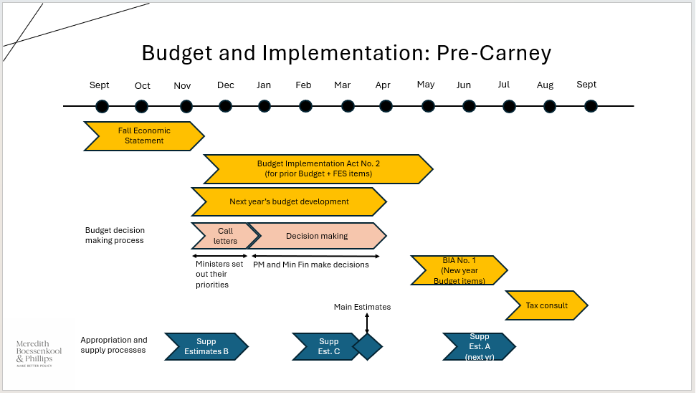
For simplicity I have omitted from here earlier steps associated with gaining policy approval which can either precede budget consideration, be given by fiat through the PM's authority during the budget process, or come after the Budget announcement but before appropriation occurs.
Even if something is urgent and ready to move rapidly without a fulsome cabinet conversation it still needs to go through a budget planning and approval process (rose and yellow blocks on the diagram), with appropriate two-pagers and policy vetting, that will in turn span several months and be signed off by the PM and Finance Minister. Should it be approved and announced in the budget, there is then the issue of a supply cycle to provide the given new program authorities to spend money, hire people and contract.
A critical step that is often overlooked by activists and advocates is the role that Treasury Board plays at this juncture in helping oversee implementation. In this case, TB Ministers may have guiding instructions from a PM Budget Decision that will set conditions on how access to funding is to be gated.
There are likely also to be other issues and considerations that TB officials – who themselves are not involved in the budget process and will not have seen a program initiative usually until it is announced to the world the same day in a budget – will want to flag and work through before bringing a departmental submission forward. All of this takes additional time after the Budget and needs to be sequenced to hit the right timelines in order to be attached to the earlier supply process (blue items on the diagram).
A program announced in the Budget, even high-profile signature new initiatives, are usually not ready for and approved at TB until Supplementary Estimates B or C in the fall/winter. Think about that for a second – an initiative announced in a March/April Budget may not get presented to Parliament for appropriation until at the earliest October and not approved until December that year. If successful, this leaves just three months in the remainder of the fiscal year to begin the process of ramping up capacity. That is before any new staff has been hired, a program has been stood up and grants and contributions can move to actually have an impact in solving a problem.
As is often the case, nearly 18 months can go by between the time that an idea was birthed into the public consciousness and anything begins to move in noticeable ways to the average citizen. If the goal is to build more housing, crack down on crime by hiring more officers with new policing powers, or address critical data sovereignty issues by building a Canadian cloud network – it can be years before anything happens.
In today’s world this is simply unacceptable and breeds mistrust, simply because Treasury Board and Finance can’t find a better way to condense the process in collaboration with Parliament.
This is where the changes announced by PM Carney are potentially transformative from a public administration perspective.
To the extent that flipping the calendar means presenting a budget about five months (assuming a late October/early November convention) before the start of the fiscal year the following April, this has the potential to bring forward in time a lot of the pre-development work so that supply cycles and program implementation better align. Programs announced in the Budget should now mostly appear in Supplementary Estimates A, meaning they will be approved by June, leaving at least three quarters of a fiscal year for departments to actually get on with things.
If this results in “faster” implementation (moving timelines up) fewer dollars will lapse between fiscal years and there should be some greater degree of responsiveness between what is planned and what happens. That being said, these timelines are still too long and greater effort will be needed by officials to meet the level of ambition that a Carney government that moves “at scale and at speed” will have of itself.
Doing this will require public servants to think much further down the field when they are developing ideas in advance of a budget. This will now be done much earlier before the arrival of the next fiscal year. That longer-term horizon will necessitate a perspective that steps a bit outside of the immediacy that the public service often lives within. Whether they can do this is another challenge for another day.
But if we can actually get things done more in line with originally set out expectations, it could have the effect of improving public trust. That would be a real win.
Potential Risk to the Fiscal Outlook and Baseline Setting
If there is one area where this change has the potential to create new risks for the government, it is in how the revised timelines impact budget planning itself.
At the core of every budget is a fiscal and economic baseline. This baseline is built on the foundation of a quarterly survey of chief economists – drawn from 11 financial institutions, pension funds and universities. Every three months these chief economists are asked to submit a rolling 5-year forecast of their estimate of what will happen across 11 macroeconomic variables (including nominal GDP level, real GDP growth rate, bond yields, currency rates, WTI oil prices, etc).
From these 605 data points an average forecast is constructed to establish long-run historical relationships between the movement of these variables and fiscal and economic dynamics; for example how a changing unemployment rate will affect Employment Insurance expenditures, and how changing interest rates will impact borrowing costs and revenues.
When we assess a budget we often put all our attention on the value of new measures being announced and the consequential changes in the deficit and debt. Except, the fiscal “track” is influenced as much – sometimes more – by the changing terrain beneath these things. This baseline is directly a consequence of the mood and outlook that the 11 chief economists have going into the quarterly survey that is next closest to when the budget is tabled.
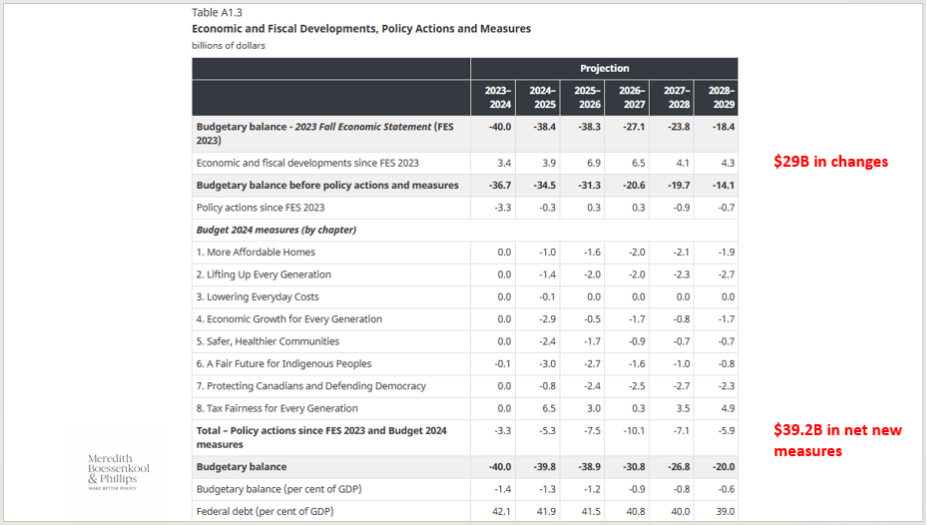
As you can see in the following table I have constructed from Budget 2024, the economic and fiscal baseline involved a total of $29 billion in changes over 5 years even before one dollar was spent or allocated. This compares to net incremental measures of $39 billion in that Budget (offset from significant capital gains measures, without which, on a gross basis, would have resulted in higher net spending). The baseline matters a lot. It determines how much margin to maneuver a Finance Minister has to work with, and ultimately the general dynamics of how a Budget will be interpreted even before it is written.
When you have a March/April Budget you would ordinarily be relying on a survey of data gathered in January and delivered in early February. In that sense, the outlook for the immediate part of the new fiscal year is relatively fresh.
In the new fiscal planning cycle, it’s likely that chief economists will now be surveyed around September, to opine on a fiscal year that is now six to seven months away. This may not seem like much of a difference, but in the current period of high uncertainty in which we are operating, forecasting is much harder.
No one would have predicted in September of 2024 that by April Pierre Poilievre would have lost the election and Mark Carney not only would have replaced Justin Trudeau but would have come within a few seats of winning a majority government. That sea change in the political outlook of the country occurred during the same forecast period that economists will now be expected to look through. The same unpredictability applies to the economy.
Why does this matter?
In periods of increased uncertainty most people, economists included, tend to herd into pre-established patterns of thinking. Mean reversion is fine if we are talking about what will happen to nominal GDP in three to five years. There are many future budgets in which to adjust for that. But in the short to medium term it can have a big impact on the budget. To the extent that economists respond to this increased uncertainty in the near term by downgrading their outlook on growth, this will translate into potentially higher expenditures and lower revenues, making the debt and deficit whole that PM Carney has to deal with potentially worse.
Consider that a one point reduction in real GDP typically results in higher deficits of about $5 billion a year for several years thereafter.
I could well be wrong about all this – and it’s true that other countries face some of the same planning challenges. But this is still an important dynamic that could have big dollar impact and consequences for departments, stakeholders and advocates.
The Importance of Transparency
Overall, there are reasons to be hopeful about the proposed change in the fiscal calendar. Bringing the budget forward in time will increase transparency and help improve the capacity of public institutions to deliver in ways that address what were often fair criticisms of where Justin Trudeau’s ambitious policy agenda fell short.
But the way Ottawa works will be different and the binding constraints potentially more significant than most people have assumed about a relatively anodyne change in dates. As we are learning about Carneynomics, that might be the point.